








Download the report
Indian family businesses: The age of reinvention
PwC’s 12th Family Business Survey

Overview
Family businesses around the world are navigating a decade defined by unprecedented complexity. From geopolitical realignments and technology acceleration to rising stakeholder scrutiny, family businesses are operating in a fundamentally transformed landscape. Capital cycles are tightening, industries are converging, digital disruption is accelerating, and the margin for error is narrowing. Against this backdrop, India’s family enterprises stand out for their optimism, agility, and long-term orientation. The India findings of our Global Family Business Survey also highlight the need to strengthen digital enablement, governance, succession planning and risk preparedness. The report blends global trends with India-specific insights, presenting a narrative of confidence, structural evolution, and reinvention.
Our perspective: India’s family businesses have been contributing the predominant share to the country’s GDP and employment. In a decade defined by a young workforce, digital acceleration, and rising global relevance, their purpose-driven ethos, patient capital, and deep people commitment position them uniquely for India’s next growth curve.
The report interprets the findings of our 12th Global Family Business Survey through the lens of how purpose, patience, and people will shape the contribution of India’s family businesses in the narrative of ‘kal ka Bharat’.
Impact
0%
of Indian family businesses expect growth in the next two years, outpacing global peers.
> 0%
of respondents in India are pursuing aggressive expansion strategies, compared to just 16 globally.
0%
of the Indian family businesses priorities Digital transformation and AI adoption.
91%
of Indian family businesses have clearly defined family values which function as their strategic compass (global: 83).
> 0
of Indian family businesses lack cross-industry board representation and 42 have no women directors.
Our perspective on key themes:
India’s six defining forces reflect that a deeper shift is underway. As the country enters a demographic peak and a period of accelerated digital expansion, family enterprises are emerging as architects of ‘kal ka Bharat’, converting structural strengths into long-term advantage. These themes not only highlight where India diverges from global patterns but also reveal how purpose, patience, and people-centric stewardship are shaping a uniquely Indian model of resilience and growth. What follows is a deeper exploration of each theme and the survey findings that highlight their impact.
Leader quote

Family businesses around the world are navigating a decade defined by unprecedented complexity. From geopolitical realignments and technology acceleration to demographics shifts, regulatory complexities, sustainability imperatives, and rising stakeholder scrutiny, family businesses are operating in a fundamentally transformed landscape.
Key themes and survey findings
Family businesses across the world are operating in an environment shaped by faster business cycles, heightened transparency demands, regulatory shifts, cyber risks, and demographic change. Yet within this global volatility, India’s family enterprises are charting a sharply different trajectory. While only a quarter of global family businesses achieved double-digit growth last year, more than half of Indian respondents expect strong expansion ahead and very few anticipate a decline. This divergence reflects India’s economic momentum and an entrepreneurial instinct that continues to drive confidence, agility, and long-term orientation.
These distinctions set the stage for the seven themes shaping the evolution of India’s family business landscape.
Growth and sentiments - Unmatched ambition
Which of the following best describes your company’s ambitions for the next two years?
Risk and resilience: India’s response to global uncertainty
Most impactful global megatrend on family business in the past year
Technology and digital maturity—moving from digitisation to intelligence
Investment approach in emerging technologies
Succession readiness—India’s most sensitive transition
Challenges faced with next-generation preparation
Governance gaps—from familiarity to future readiness
Key takeaways
India’s family businesses are entering a decisive decade. Growth momentum is strong, but the future will be shaped by enterprises that deepen their purpose, invest in people, strengthen governance, and exercise patience in capital allocation and long-term decision-making.
Five defining transitions ahead
Digital adoption will progress towards intelligence-driven organisations where AI-enabled foresight, predictive analytics, and data-led governance shape strategic decisions and competitive advantage.
Risk responses will shift from reactive and event-driven to structured resilience built on scenario planning, future capability development, stronger governance, and generational alignment.
Rapid decision-making will mature into consistent, reliable, and structured operating models that balance speed with discipline, enabling scale across geographies, entities, and generations.
Leadership models will increasingly blend entrepreneurial instinct with professional depth, bringing non-family expertise, modern skills, and institutional leadership pathways to support sustainable growth.
Family values will evolve into structured governance frameworks that include formal family constitutions, clear shareholder agreements, explicit policies, and well-defined succession structures. This shift will anchor decision-making and continuity as businesses expand.
Hear from our leaders
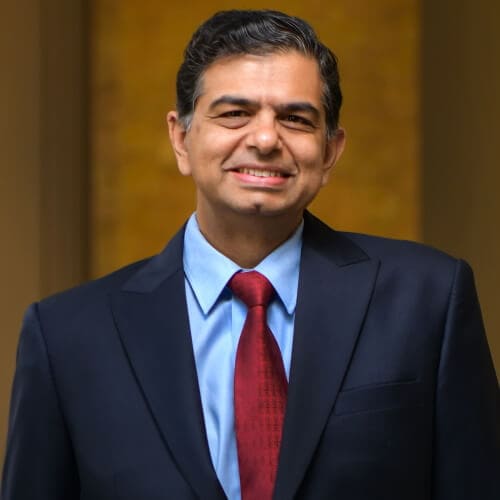
At a time of global uncertainty, Indian family businesses stand out for their confidence and ambition. Our survey highlights a strong belief in India’s economic momentum, with family enterprises looking beyond stability to pursue expansion, new adjacencies, and professionalised leadership models. This optimism is rooted in deep purpose, long‑term thinking, investments in tech & interest in AI, and resilience built over generations.
Sanjeev Krishan
Chairperson, PwC in India

Indian family businesses are entering the next decade with a distinctive combination of confidence and ambition. While global peers are exercising caution, Indian enterprises are leaning into growth, partnerships, and reinvention.
Manpreet Singh Ahuja
Partner and Chief Clients and Alliances Officer, PwC India

Indian family businesses continue to show strong confidence and growth intent, alongside a more deliberate focus on sustaining that growth. As businesses scale, families are placing greater emphasis on governance, leadership continuity, and alignment between ownership and management. Long-term success will increasingly depend on institutionalised and tech-enabled decision-making, effective risk management, and preparing the next generation, while preserving core family values.
Falguni Shah
Partner and Entrepreneurial and Private Business Leader, PwC India
Contributors
Prateek Chourasia and Poojita Oberoi
Contact us
Manpreet Singh Ahuja
Chief Clients & Industries Leader, PwC India
Falguni Shah
Partner & Leader Entrepreneurial and Private Business, PwC India
Rajib Basu
Partner and EPB East Market leader, PwC India
Rajesh Vig
Partner and EPB West Market leader, PwC India
Aman Goel
Managing Director, PwC India
Follow PwC India


