








Union Budget 2026

Finance Minister Nirmala Sitharaman presented Union Budget 2026 on 1 February, marking her ninth consecutive budget address. The Economic Survey 2026, presented on 29 January, projects that India's economy will grow by 7.4% in FY26 and between 6.8–7.2% in FY27. This growth is expected to be supported by regulatory reforms, a robust macroeconomic foundation, and a revitalised emphasis on private sector investment.
India currently stands at a crossroads, and Union Budget 2026 seeks to push the nation into its next phase of transformation, with Viksit Bharat as the overarching theme. PwC India’s Union Budget insights and analysis spotlight the priorities that can accelerate this growth. This Budget represents an opportunity to place India on the path towards financial stability while enabling businesses to be future ready—especially as they navigate the opportunities of AI adoption alongside challenges around talent, infrastructure, governance, and trust. PwC India’s subject matter experts outline the Union Budget reforms and sector-specific initiatives that can reinforce India’s economic foundation and unlock new engines of inclusive, sustainable growth.
A message from our leader
This year’s budget marks a decisive shift in how India is shaping its growth story. It reflects a country thinking beyond consumption by strengthening its services engine while steadily emerging as a credible manufacturing destination.
What stands out is the clear long‑term view. The emphasis is on building physical, digital and human capability, enabling investments, boosting productivity, and supporting the sectors that will drive the next wave of global competitiveness.
Sanjeev Krishan, Chairperson, PwC in India, shares what this means for businesses. His message is focused and forward‑looking, to take the long view, invest in innovation and build the foundations that will power India’s next phase of growth.
A message from our leader
Key takeaways from The Economic Survey 2026
The Economic Survey 2026 tells the story of an economy which is not just growing but is also steadily maturing with strong fundamentals and rising institutional capacity.
Growth remains broad-based, financial intermediation is deepening, banks and corporate balance sheets are healthy and public capital expenditure continues to bring down logistics costs. The emphasis is shifting from demand-led expansion to productivity-led growth, with focus on improving infrastructure, institutional capacity, and supply-side efficiency.

Strong bank credit growth, rising market-based funding and improving non-bank channels point to a more diversified and resilient financing structure. This, in turn, supports domestic investment while enhancing the confidence in the Indian currency.

The Survey signals the quiet strengthening of India’s economic buffers. Diversified funding sources, steady foreign investment and expanding export capabilities underline a long-term objective where competitiveness, not insulation, is the foundation of stability.

India’s path to economic development is framed around two key parameters: building strategic resilience and indispensability. The focus is on developing domestic capabilities that make India a reliable and credible participant in global value chains, supported by outcome-oriented institutions and regulatory credibility.

Swadeshi is inevitable for building scale, productivity and technological depth at home while competing globally. MSMEs are placed at the centre, along with targeted manufacturing in high-value, specialised segments.

The agriculture sector is diversifying its operations towards higher-value activities as allied sectors are gaining prominence, logistics capacity is expanding and physical and digital connectivity continues to improve.

Webcasts
Union Budget 2026-27
The webcast provided an overview of the current macroeconomic environment and the direction set by Union Budget 2026–27, highlighting how policy priorities, fiscal choices, and structural reforms are shaping India’s growth trajectory. It also explored the evolving business and investment landscape across key sectors, along with important tax and regulatory developments and their implications for organisations.
Should you wish to discuss any aspect of the Budget in more detail or explore its implications for your business, please feel free to connect with your relationship contact at PwC.

Union Budget 2026-27 analysis (PDFs)

Union Budget 2026–27: Catapulting India’s next growth leap
Budget 2026-27 charts a path for India’s continued growth, reinforcing the government’s commitment to fiscal discipline and reform-led progress. Key focus areas include scaling up manufacturing across strategic and frontier sectors; supporting micro, small, and medium enterprises; enhancing infrastructure and energy security; deepening the services sector as an employment engine; investing in human capital; and promoting balanced regional development through city economic regions and targeted initiatives. From a tax perspective, the new Income-tax Act, 2025, is set to come into force from 1 April 2026 with select amendments proposed to both existing income-tax law and the new code.

Union Budget 2026-27: Financial Services
Union Budget 2026 creates new pathways for a future ready economy that will fulfil the ‘Viksit Bharat’ dream. The financial services sector will be one of the key engines driving this change. The Budget’s focus has been on regulatory transformation and a new tax framework that is simple and easy to adopt. Details follow in our flyer on the financial services sector that helps you decode the evolving landscape.
Hear from our leaders
“Budget 2026 is anchored in India’s potential and vision of becoming ‘Viksit Bharat’ by boosting employment, while combining technologies of the future with India’s legacy industries. This is a push for resilience to drive long-term, equitable, and sustainable growth backed by a ‘Kartavya’ approach.
Sanjeev Krishan, Chairperson, PwC in India

“A Union Budget focused on reform and increasing the speed of doing business. With a clear sector-first approach across manufacturing, technology, and pharma, it unlocks innovation, boosts competitiveness, and reinforces execution—paving the way for India to emerge as a global leader in industry and innovation, in line with the vision of Viksit Bharat.
Arnab Basu, Chief Industries Officer, PwC India

“Union Budget 2026 charts a decisive course for inclusive growth and enhanced global competitiveness, unlocking new opportunities for enterprises, boosting MSMEs, and empowering women entrepreneurs to scale and lead.
Vivek Prasad, Partner and Chief Commercial Officer, PwC India

“For the technology ecosystem, the standout move is India’s push to become a global cloud and data infrastructure hub through a tax holiday till 2047, supported by a more predictable tax and compliance regime that reduces uncertainty, boosts capital confidence and enables faster global scaling.
For telecom and connectivity‑led businesses, capital efficiency rises as regulation simplifies, supply chains strengthen, and domestic electronics capacity expands. ISM 2.0 and the expanded Electronics Components Manufacturing Scheme can reinforce the device‑to‑network stack and build a stronger backbone for next‑generation use cases.
For media and entertainment, the Orange Economy push, especially widespread AVGC creator labs, can build a strong talent pipeline for content, gaming and immersive storytelling. Together, these measures strengthen the TMT flywheel with better infrastructure, innovation, trust, and growth toward Viksit Bharat.
Manpreet Singh Ahuja, Partner, Chief Clients Officer and TMT Leader, PwC India

Budget reactions
Tax & Regulatory Services

Budget 2026 marks a decisive shift toward a more certain, simplified, and technology-enabled tax regime, emphasising trust-based administration, faster dispute resolution, and reduced compliance complexity. By enhancing tax certainty for global capability centers and technology investors, and adopting FTA-aligned tariff strategies that balance domestic value addition with global competitiveness, the Budget paves the way for a more business-friendly environment for both domestic and international stakeholders.
Kunj Vaidya
Partner and Tax & Regulatory Services Markets Leader, PwC India
Climate and energy

The Union Budget 2026 strengthens India’s clean-energy leadership by boosting resilience, supply-chain sovereignty, and unlocking value through financial reforms to position India as a global clean-energy transition leader.
Sambitosh Mohapatra
Partner and Leader, Climate and Energy, PwC India
ESDM and semiconductor

As someone who is deeply invested in India’s tech ecosystem, I warmly welcome Union Budget 2026–27’s visionary and strategic advancements for the electronics and semiconductor sector. ISM 2.0 prioritises domestic production and innovation, while the ₹40,000 crores Electronics Components Manufacturing Scheme strengthens India’s push to become a global leader in semiconductors and electronics.
Sujay Shetty
Managing Director, ESDM and Semiconductor, PwC India
CP&I and industrial development

Cities continue to be positioned as key growth engines, and the Semiconductor Mission 2.0 could develop self-reliance for emerging industries and advance the government’s vision of Viksit Bharat@2047.
Mohammad Athar Saif
Partner and Leader, CP&I and Industrial Development, PwC India
Health industries

The Budget’s focus on biomanufacturing, skills development, and faster approvals signals a strong boost to India’s biopharma sector, while emphasising medical tourism and Ayurveda to strengthen India’s global healthcare leadership.
Sujay Shetty
Partner and Leader, Health Industries, PwC India
Economy

Given the fiscal constraints, the Budget was on expected lines with the fiscal deficit for FY26 being met and the FY27 target being just 10 bps lower with the debt-to-GDP ratio targeted to be lowered by 50 bps.
Ranen Banerjee
Partner and Leader Economic Advisory, PwC India
Financial services

Union Budget 2026–27 aims to strengthen financial resilience through banking reforms, bond incentives, FEMA review, and higher Securities Transaction Tax, signalling a reform-led push towards a deeper, more inclusive financial ecosystem.
Gayathri Parthasarathy
Partner and Leader, Financial Services, PwC India
Infrastructure and logistics

The Budget shifts focus from rapid capex growth to enabling better execution, addressing lender risks with credit guarantees, unlocking asset value through REITs, and promoting infrastructure development via high-speed rail corridors and City Economic Regions.
Manish Sharma
Partner and Leader - Infrastructure, Transport and Logistics, PwC India
Telecom

With India doubling down on digital infrastructure, these reforms speed up capacity addition, deepen global capital inflows, and strengthen the country’s position as a scalable, cost‑competitive hub in the global data centre landscape.
Vinish Bawa
Partner and Leader Telecom, PwC India
Manufacturing

Budget 2026 moves manufacturing from intent to capacity creation, scaling select sectors, reviving legacy clusters and strengthening MSMEs—while long-term impact will depend on sustained, fast-paced execution across the industrial ecosystem.
Vinod Kumar
Partner and Leader, Manufacturing, PwC India
Agriculture

Union Budget 2026–27 reinforces India’s commitment to agricultural innovation, export competitiveness, and women’s empowerment—key pillars of the Viksit Bharat strategy.
Shashi Kant Singh
Partner, Agriculture, Food and Agribusiness, PwC India
Technology
Union Budget 2026 accelerates India’s tech transformation—championing digital infrastructure, AI, and skills development to make India a global innovation hub.
Navnit Nakra
Partner and Leader, Technology Sector, PwC India
Transport and logistics

The Government’s focused outlay and targeted reforms reinforce India’s commitment to lowering logistics costs and enabling efficient, resilient and sustainable trade through digitisation, modal-shift incentives and strengthened transport manufacturing ecosystems.
Dhruv Gadh
Partner, Transport and Logistics, Infrastructure and Resilience, PwC India
Insurance

The Budget’s focus on growth and infrastructure strengthens the long-term outlook for insurance penetration and risk protection in India.
Amit Roy
Partner and Leader, Insurance and Allied Businesses, PwC India
Media, entertainment and sports

Union Budget 2026–27 sets a bold target of 2 million AVGC professionals by 2030, placing ‘digital storytelling’ at the core of India’s emergence as a global creative powerhouse.
Rajesh Sethi
Partner and Leader, Media, Entertainment and Sports, PwC India
Aviation ad hospitality

Budget 2026’s emphasis on VGF-backed seaplane operations and indigenous manufacturing can strengthen regional and coastal connectivity, catalyse tourism-led development, and bridge infrastructural gaps, thereby aligning with the Viksit Bharat vision.
Sahil Mahajan
Partner, Aviation, Airports and Hospitality, PwC India
Healthcare

Budget 2026 elevates healthcare to a strategic priority, focusing on digital innovation, workforce development, and biopharma growth to build a future-ready and accessible system.
Dr Rana Mehta
Partner and Leader, Healthcare, PwC India
Key features

Income tax exemption limit raised to ₹12 lakh under the new regime.

Enhanced credit guarantee cover for MSMEs from ₹5 crore to ₹10 crore.

Launch of Prime Minister Dhan-Dhaanya Krishi Yojana to boost agricultural productivity.

Introduction of a 6-year Mission for Aatmanirbharta in Pulses focusing on Tur, Urad and Masoor.

Establishment of a Makhana Board in Bihar for improved production and marketing.
Enhanced loan limit under Kisan Credit Cards from ₹3 lakh to ₹5 lakh.

Significant increase in the number of Atal Tinkering Labs in government schools.

Broadband connectivity to be provided to all government secondary schools and primary health centres.

Launch of a comprehensive programme for vegetables and fruits in partnership with states.

Expansion of medical education with 10,000 additional seats in the next year.

Setting up of Day Care Cancer Centres in all district hospitals within three years.

Introduction of a new scheme for first-time entrepreneurs from women, SCs, and STs.

Launch of a National Manufacturing Mission to further "Make in India".

Extension of the Jal Jeevan Mission until 2028 to achieve 100% potable tap water coverage.

Establishment of a Maritime Development Fund with a corpus of ₹25,000 crore.

Modified UDAN scheme to enhance regional connectivity to 120 new destinations.

Launch of a Nuclear Energy Mission for research and development of Small Modular Reactors.

Introduction of a new income-tax bill to simplify and reduce litigation.

Increase in FDI limit for the insurance sector from 74% to 100%.

Setting up of an Urban Challenge Fund of ₹1 lakh crore for city redevelopment projects.

Reduction in customs duty on critical minerals to boost domestic manufacturing.

Full exemption of customs duty on 36 lifesaving drugs and medicines.

Launch of a Deep Tech Fund of Funds to support next-generation startups.

Extension of the period of incorporation for startups to avail benefits until 1.4.2030.

Introduction of a presumptive taxation regime for non-residents in electronics manufacturing.

Setting up of a National Digital Repository of Indian knowledge systems.
Union Budget 2026 Highlights - Tax Perspective
- To mitigate the impact of higher US tariffs on Indian exports, Union Budget FY 2026─27 extends and liberalises duty-free import schemes for specified inputs used in export-oriented sectors—leather, synthetic footwear, and shoe-uppers for textiles, and marine and seafood processing. This move is aimed at reducing input costs and enhancing export competitiveness in these segments.
- Trade facilitation is further strengthened through customs measures that reinforce trusted trader programmes and the Advance Ruling framework.
- The validity period for advance rulings has been extended from three years to five years, subject to changes in facts or law, providing greater certainty and predictability for importers and exporters.
- The duty-deferral period for Tier 2 and Tier 3 authorised economic operators (AEOs) has been enhanced from 15 to 30 days, and this facility is now also available to eligible manufacturer-importers, encouraging broader participation in the AEO programme and enhancing the management of working capital needs.
- The Budget also provides a significant boost to the manufacturing sector by granting tariff exemptions for the import of:
- Raw materials and parts/components used in generating nuclear power
- Capital goods used in the manufacture of lithium-ion cells for batteries intended for battery energy storage systems (BESS)
- Raw material for manufacturing parts of aircraft for maintenance, repair, and overhaul (MRO) when imported by public sector units (Ministry of Defence)
- Parts and components for manufacture of civilian aircraft and parts of such aircraft.
- In terms of ease of doing business, the rollout of the Customs Integrated System (CIS) is planned within two years, aiming to streamline and digitise customs processes. Additionally, the requirement for prior permission to remove warehoused goods from one custom bonded warehouse to another has been eliminated, further simplifying logistics and reducing compliance burdens for businesses.
A. Promoting investments in India
Tax holiday for foreign companies procuring services from Indian data centres
Any income accruing or arising in India or deemed to accrue or arise in India to a foreign company by way of procuring data centre services from a specified data centre in India would be eligible for a tax holiday up to 31 March 2047, subject to the condition that all sales by such foreign company to users located in India are made through an Indian reseller entity and that such foreign company does not own or operate any physical infrastructure or resources of the data centre.
Safe habour margin for data centre entities
A safe harbour margin of 15% on costs is proposed for companies providing data centre services to related entities.
Tax holiday for foreign companies providing capital equipment to Indian contract manufacturers
A foreign company earning income from providing capital goods, equipment, or tooling to an Indian contract manufacturer company located in a custom bonded area who produces electronic goods on behalf of such foreign company is exempt up to tax year 2030–31.
Extension of period of tax holiday for units in International Financial Services Centre (IFSC) and rationalisation of tax rate
The period of tax holiday available to units located in an IFSC shall be extended to 20 consecutive years, to be selected at the option of the taxpayer, out of a total span of 25 years. A concessional tax rate of 15% (plus surcharge and cess) shall apply during the non-tax holiday period.
Deemed dividend exemption for Global Treasury Centres is proposed to be restricted to cases where the counterparty group entity is located in a notified country or territory outside India.
B. Ease of doing business
Information Technology Services (ITS) safe harbour rules
Software development services, IT-enabled services, knowledge process outsourcing services, and Contract R&D services (related to software development) are proposed to be consolidated into a single safe harbour category of ‘Information Technology Services’ with a uniform safe harbour margin of 15.5%.
The eligibility threshold for availing safe harbour for ITS is proposed to be enhanced from INR300 crore to INR2,000 crore for value of international transactions.
It is proposed that safe harbour for IT services be granted through an automated, rule-based process and can be continued for a period of 5 years at the option of the taxpayer.
APA-related amendmentss
A unilateral APA process is proposed to be fast-tracked with a targeted conclusion within two years for IT services providers, which is further extendable by six months upon the taxpayer’s request. The facility of filing modified returns is proposed to be extended to the associated enterprises as well.
C. Key policy-related measures for financial services
- Proposal for setting up a ‘High Level Committee on Banking for Viksit Bharat’ to comprehensively review the sector and to align it with India’s next growth phase
- Comprehensive review of Foreign Exchange Management Act (FEMA) (Non-Debt Instruments) Rules proposed for a contemporary investment framework
- Proposal to introduce a market-making framework and total return swaps (TRS) for corporate bonds to enhance liquidity
- Persons Resident Outside India (PROIs) to be permitted to invest in listed Indian equities with increased limits from 5% to 10% per individual, and from 10% to 24% in aggregate under the Portfolio Investment Scheme
- A dedicated INR100-billion Small and Medium Enterprises (SME) Growth Fund has been introduced. Additionally, to enable access to risk capital to micro enterprises, an INR20 billion top-up is proposed to the Self-Reliant India Fund.
D. Rationalisation of provisions and miscellaneous changes
Rationalisation of buy-back provisions
The tax provisions with respect to buy-back of shares are proposed to be rationalised by taxing the consideration on buy-back of shares as capital gains. Promoters (including those holding more than 10% shares) are required to pay an additional income tax on gains arising from a buy-back as follows:
| Type of capital gains | Promoter being a domestic company | Other promoters |
| Short term | 2% | 10% |
| Long term | 9.5% | 17.5% |
Rationalisation of penalty provisions
The imposition of penalty for under-reporting and misreporting of income is now required to be made part of the assessment order itself. Furthermore, interest on the penalty will be kept in abeyance during the pendency of appeal by the first appellate authority.
Penalties for certain defaults, namely failure to get accounts audited, failure to furnish transfer pricing audit report, failure to furnish statement for financial transactions or reportable accounts, are converted into fees.
Immunity from penalty which was previously available only for under-reporting of income is now extended to cases of misreporting as well. However, in such cases, the taxpayer would be required to pay 100% of the tax amount as additional income tax over and above the tax and interest due, in addition to the previously applicable conditions.
Rationalisation of prosecution provisions
The nature of imprisonment for most offences is changed from ‘rigorous imprisonment’ to ‘simple imprisonment’, making the punishment less severe. The maximum punishment for most offences is reduced from seven years to two years (three years for repeated offences). Graded thresholds are introduced for offences based on the quantum of tax evaded. Certain offences (e.g., TDS on benefits and perquisites, failure to produce accounts and documents) are fully decriminalised and will now attract only a fine.
Retrospective amendment on time limit for passing of assessment order
The controversy regarding the time limit for passing assessment orders, specifically whether the period taken by the Dispute Resolution Panel (DRP) should be included in the computation of the time limit for passing the final assessment order, has now been clarified. A retrospective amendment has been proposed to section 144C, to clarify that the additional time provided under section 144C is available in cases where the DRP route is followed. This amendment ensures that the time taken by the DRP is not subsumed within the general time limits under sections 153 or 153B, but is instead in addition to those limits.
Removal of interest deduction against dividend income/mutual fund income
Deduction for interest expenses incurred in connection with earning dividend income or income from mutual fund units has been withdrawn.
Extending the period of filing revised return
The time limit for filing revised return of income has been extended to 12 months from the end of the tax year (i.e. March) from the existing time limit of nine months from the end of the tax year (i.e. December) along with an additional fee of INR1,000 (if income does not exceed INR5,00,000) and INR 5,000 (otherwise).
Scope of updated tax return
Updated tax return can be filed in cases where there is a reduction of the amount of loss as compared to the original return. Updated tax return can also be filed in cases where reassessment proceedings are initiated subject to payment of additional income tax of 10%.
Increase in securities transaction tax (STT)
STT on futures has been raised to 0.05% from 0.02%, and STT on options transactions has been raised to 0.15% from 0.1%/ 0.125%.
From a customs standpoint, the aim of Union Budget 2026 has been to simplify the tariff structure, support domestic manufacturing, and promote export competitiveness. Further focus has been on trade facilitation through a more digital, trust-based, and simplified regime, while selectively reducing duties to support priority sectors. Key changes proposed in the Union Budget are as under:
- Special Economic Zone (SEZ) to Domestic Tariff Area (DTA) sales: A special onetime measure to permit manufacturing SEZ units to sell into the DTA at a concessional duty rate limited to a proportion of their exports.
- Enabling trade digitisation, trust-based systems, and ease of doing business
- A Customs Integrated System to be rolled out as a single and interconnected digital window for all approvals from customs and partner Government agencies
- Enabling risk assessment across all ports through non-intrusive scanning with advanced imaging and AI technology
- Duty deferral payment period is increased from 15 to 30 days for Authorised Economic Operator (AEO) Tier-2 and Tier-3 importers. To incentivise the manufacturer importer to obtain AEO certification, the deferment facility has also been extended to them up to 31 March 2028.
- The validity of customs advance rulings has been extended from three to five years. Existing rulings are to be extended on request of the applicant.
- Strengthening the warehousing ecosystem
- The requirement to seek an officer’s permission for movement of warehoused goods from one bonded warehouse to another has been done away with.
- The introduction of a warehousing framework with a focus on self-declaration, electronic tracking, and risk-based audit has been proposed to reduce dependency on office-dependent approvals.
- Baggage reforms
- New Baggage Rules & Regulations introduced with effect from 2 February 2026 to allow greater baggage allowance (₹75,000), facilitate baggage clearances, and consolidate related procedures into a single framework
- Tariff rationalisation
- Exemptions continued: Parts/components for use in the manufacture of lithium-ion batteries and battery packs; goods for manufacture or the maintenance of wind-operated electricity generator components
- Exemptions introduced: Capital goods for use in lithium-ion cell manufacturing for battery energy storage systems; specified goods for use in manufacture of solar glass; goods required for setting up of specified nuclear power projects irrespective of their capacity
- Exemptions discontinued: Sectors such as chemicals, renewable, electrical, electronics, and medical equipment
- Revision/rationalisation of Agricultural Infrastructure Development Cess (ADIC) and/or Social Welfare Surcharge (SWS)
- Basic Customs Duty (BCD) rate on import of dutiable goods for personal use reduced from 20% to 10% with effect from 1 April 2026
- Section 13(8)(b) of the Integrated Goods and Services Tax (IGST) Act has been omitted, and the place of supply for intermediary services will now be determined based on the location of the recipient. This aligns the provision with the general rule under Section 13(2) and enables such services provided to foreign recipients to qualify as exports.
- The conditions for issuing credit notes for post‑supply discounts have been simplified. A prior agreement or invoice linkage is no longer required. Credit notes will be valid as long as the recipient reverses the proportionate input tax credit in accordance with Section 34 of the Central Goods and Services Tax (CGST) Act.
- Effective 1 April 2026, the Government has been authorised to notify an existing authority or tribunal as the National Appellate Authority for Advance Ruling (NAAR). This aims to streamline the advance ruling process by providing a central appellate mechanism, ensuring consistency and reducing interpretational disputes across states.
Key direct tax proposals
Webcast
The budget provides a framework of transformative reforms across six key domains which will augment India’s growth potential and global competitiveness: (i) taxation; (ii) power sector; (iii) urban development; (iv) mining; (v) financial sector; and (vi) regulatory reforms. This webcast covered key budget announcements, economic indicators and industry experts’ perspectives to help you navigate the evolving business landscape.
Webinars

Union Budget 2025-26
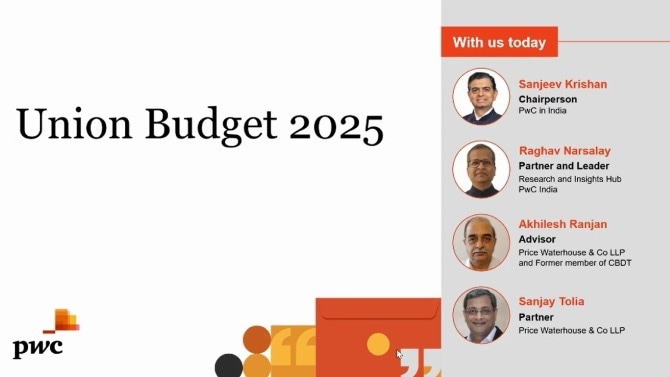
Aligned with the vision of becoming Viksit Bharat by 2047, it is anticipated that the Government will take targeted measures to strengthen manufacturing capabilities, supporting the expansion of global capability centres (GCCs), simplifying tax regulations to facilitate ease of doing business and providing impetus to make India an attractive investment destination.
Join our panel of subject matter experts for a webinar as they decode Union Budget 2025 and provide a deep dive into the key policy announcements and implications for businesses.

Speakers
Sanjeev Krishan
Chairperson
PwC in India

Sanjay Tolia
Partner
Price Waterhouse
& Co LLP

Akhilesh Ranjan
Advisor
Price Waterhouse & Co LLP
and Former member of CBDT
Raghav Narsalay
Partner and Leader
Research and Insights Hub
PwC India
Impact of budget announcements for foreign portfolio investors and capital markets

Day and date:
Monday, 3 February 2025

Time: 9:30am (India) | 3pm (Sydney) | Noon (Singapore/Hong Kong

Click here to register
Day and date:
Monday, 3 February 2025
Time: 8:30pm (India) | 3pm (London) | 10am (New York)
Click here to register
Speakers

Gautam Mehra
Partner, PwC India

Suresh Swamy
Partner, Price Waterhouse & Co LLP
Key highlights

Budget bytes
Union Budget 2026: Building the foundations of India’s next
Union Budget 2026: Building the foundations of India’s next growth wave
Sanjeev Krishan, Chairperson, PwC in India, shares what this means for businesses. His message is focused and forward‑looking, to take the long view, invest in innovation and build the foundations that will power India’s next phase of growth.
Union Budget 2026: Catalysing India’s full-stack AI and
Union Budget 2026: Catalysing India’s full-stack AI and digital economy
Union Budget 2026 sets the stage for India’s full-stack AI economy, focusing on digital infrastructure, trust-centric governance and talent development to fuel tech-led growth. Manpreet Singh Ahuja, Chief Clients and Alliances Officer, PwC India, highlights how these moves position India as a global hub for cloud, data and emerging technologies.
Fiscal prudence takes centre stage
Fiscal prudence takes centre stage
This year’s Budget is all about disciplined growth and sharper execution. As Ranen Banerjee, Partner and Leader, Economic Advisory, PwC India, shares in this video, the focus has shifted from introducing new schemes to consolidating and strengthening existing ones—a strategic move in a fiscally tight environment.
India forges a safer harbour for IT/ITES
India forges a safer harbour for IT/ITES
Union Budget 2026 delivers historic reforms that simplify and strengthen safe harbour rules for the IT sector. In his latest video, Kunj Vaidya, Partner and Tax & Regulatory Services Markets Leader at PwC India, breaks down what these reforms mean for businesses.
Budget 2026: Deciding India's growth strategy - Tax, policy
Budget 2026: Deciding India's growth strategy - Tax, policy and economic momentum
Kunj Vaidya, Partner and Tax & Regulatory Services Markets Leader, PwC India, and Pratik Jain, Subject Matter Expert and Partner, Price Waterhouse & Co LLP, share their take on this year’s Budget, which they describe as historic for the balance it strikes between fiscal prudence and meaningful changes across tax policy.
Four-prong path to growth
Four-prong path to growth
This year’s Budget sets a clear direction for long‑term growth. As Mohammad Athar Saif, Partner and Leader, CP&I and Industrial Development, PwC India, notes in this video, four themes stand out.
Infrastructure investment remains robust. Cities emerge as powerful growth hubs. Manufacturing stays central to India’s Viksit Bharat vision, with momentum across semiconductors, electronics components and critical minerals. And digital infrastructure takes a strategic leap forward, positioning India as a global digital backbone.
Union Budget 2026: Accelerating India’s tech-enabled,
Union Budget 2026: Accelerating India’s tech-enabled, digital-first economy
Technology continues to play a defining role in India’s economic journey, and this year’s budget underscores that even more strongly. The push toward stronger digital foundations, from data platforms and cloud connectivity to cybersecurity and wider digital infrastructure, signals a long‑term approach to scale, interoperability and resilience.
Navnit Nakra, Partner and Leader, Technology Sector, PwC India, shares his perspective on what these shifts mean for businesses. His outlook highlights how the focus on skills, regulatory clarity and ease of doing business is helping reduce execution friction and positioning India as a trusted global technology and innovation hub.
Union Budget 2026: Powering India’s clean energy and
Union Budget 2026: Powering India’s clean energy and decarbonisation journey
Sambitosh Mohapatra, Partner and Leader, Climate and Energy, PwC India, outlines how key initiatives in decarbonisation, supply chain resilience, and fiscal reforms position India to lead the global clean-tech revolution.
GCCs and Manufacturing: Budget Smashes a Boundary
GCCs and Manufacturing: Budget Smashes a Boundary
Union Budget 2026 sets clear boundaries on the tax front with four key announcements aimed at enhancing ease of doing business and fostering growth in Global Capability Centres (GCCs). Vikram Doshi, Partner and Leader, GCC, Tax, PwC India, highlights the introduction of a 15.5% transfer pricing safe harbour covering over a thousand existing GCCs and all new units.
A Forward Looking Budget for Evolving India
A Forward Looking Budget for Evolving India
As India deepens its focus on strategic industries and future‑ready growth, this year’s Budget delivers a clear signal of intent. Anshul Jain, Partner, PwC India, highlights how the Budget balances support for manufacturing, semiconductors and rare earth magnets while also driving growth for startups, small businesses, and MSMEs.
Transformative Budget: Powering India's Electronics Growth
Transformative Budget: Powering India's Electronics Growth
Sujay Shetty, Managing Director, ESDM and Semiconductor, PwC India, shares insights on this transformative Budget. He highlights the launch of ISM 2.0—a bold step to boost domestic production, advance full-stack design, develop Indian IP, and strengthen the supply chain with focused R&D and skilled workforce development.
Pre-budget expectations
- Continue capex outlay (of approximately INR2.8 lakh crore in FY26) with higher allocation.
- Bring in a focus on quality and not just funding projects by enabling investments in industry-wide capability building such as training programmes linked to highway projects; fiscal incentives for mechanisation and modern construction technologies (equipment pooling and leasing organisation?); and structured skilling initiatives for O&M.
- Bring in a focus on opex (to avoid ‘build–neglect–rebuild’ challenge) by emphasising creation of a more efficient system that consciously tilts towards higher lifecycle spending, with a clear target to increase the share of opex to about 20–25% of total highway outlay by 2030 by (i) ring-fencing maintenance allocations for critical corridors, (ii) expanding performance-based O&M contracts, and (iii) creating incentives for states and concessionaires to invest in long-term maintenance rather than short-term fixes.
- Re-orient Bharatmala to ‘Complete projects faster and not just build more’ by pushing the system towards completion-centric metrics, namely projects commissioned, corridors fully operational, and economic benefits realised, instead of metrices on announcing or awarding new stretches. Completing unfinished works unlocks toll revenue sooner, enables monetisation, and delivers immediate logistics and travel-time gains to users.
- Initiate procurement reform by rethinking L1 (lowest cost approach) that leans on input-based specifications (what materials to use, what thickness, which methods) and awarding projects based on narrow price competition. Instead, focus on performance outcomes, overall value, design innovation, or risk-sharing quality, and reward sustainability and innovation.
- Enable financial products and credit enhancements to unlock capital beyond traditional banks: Infrastructure financing in India still leans heavily on domestic banks and conventional project finance structures. These institutions, constrained by sectoral caps and risk aversion, are understandably cautious - especially on models with demand risk such as BOT and other traffic-linked concessions. At the same time, international project finance and long-term capital remain under-tapped, partly due to currency risk, limited credit enhancement mechanisms, and insufficient depth in domestic bond and guarantee markets. The budget should therefore focus on enabling a broader ecosystem of financial products, without the government itself becoming a direct lender of first resort. This includes incentivising the market for: (i) expanding guarantee and insurance instruments to de-risk projects, (ii) facilitating cost-effective currency hedging products, and (iii) encouraging credit enhancement mechanisms that make infrastructure bonds more attractive to institutional investors.
By sharing risk more intelligently rather than simply pushing it onto contractors or banks, these tools can draw in both domestic and international capital at scale.
Cities occupy barely 3% of the land surface but generate close to 60% of GDP. For a rapidly urbanising country like India, this makes large-scale, well-planned investment in cities a simple economic imperative. The challenge is to do this while grappling with pollution, congestion, hygiene, safety, ageing populations, and rising expectations of convenience.
By 2030, India is expected to have at least seven megacities with populations above 10 million and over 60 cities with more than 1 million residents. All of them will demand affordable, fast, clean, and reliable public transport—just as fiscal space remains tight. Urban development is constitutionally a state subject, but the Union Government plays a critical role in enabling metro systems, electric buses, and other mass transit investments.
The question, therefore, is not whether the Centre should support urban transport, but what more it can do to accelerate sustainable, citizen-centric mobility. Five priorities stand out:
- The budgets should mandate transport models for all cities projected to be million-plus Cities by 2030 to ensure that dynamic and live, city-wide integrated transport and land-use models enable testing of the impact of proposed projects, simulate policy changes and prioritise investments based on measurable outcomes, and solve congestion by treating it not just as a transport problem but equally as a land-use and demand-management problem. For all million-plus cities, the Centre should make access to major urban transport funds contingent on:
- Establishing and regularly updating integrated transport and land-use models
- Using these models to appraise major projects (metros, BRT , elevated corridors, large road widening)
- Periodically reviewing and updating comprehensive mobility plans based on real-world performance, not just as one-time documents
- Create a Central ‘nudge unit’ for urban behaviour and design to understand what prompts civic discipline and safer behaviour, and then embedding those insights into standards, funding conditions, and capacity-building programmes. This will ensure that infrastructure is used as intended by studying how people actually use streets and public spaces, identifying design elements that improve compliance and safety (e.g. traffic calming, nudges for correct lane use, safer crossings), developing model design guidelines and low-cost interventions that cities can adopt, and evaluating existing assets (overpasses, subways, crossings) for usability and redesign where needed.
- Create five-year rolling capital commitments via non-lapsable funds: Large urban transport projects—metros, BRT corridors, depots, multimodal hubs—require long-term capital visibility. Yet, the current system of annual, stop–go budgeting creates uncertainty. Private contractors invest heavily in tunnelling machines, casting yards, and specialised equipment, and delayed or unpredictable payments increase their risk, which ultimately shows up as higher bid prices. To address this, the Centre should:
- Create a non-lapsable urban transport fund under the Ministry of Housing and Urban Affairs (MoHUA) with five-year rolling capital commitments
- Provide multi-year sanction letters for approved projects, clearly laying out expected central disbursements
- Enable faster, more predictable flow of funds directly to city or metro rail corporations, subject to agreed milestones and governance standards
- Create an operations and maintenance challenge fund: Indian cities invest heavily in creating new assets—roads, flyovers, metros, depots, electric bus fleets—but far less in maintaining and operating them well. The result is a ‘build–neglect–rebuild’ or ‘buy–neglect–repurchase’ cycle that destroys value and erodes public confidence. The Union Budget can help correct this bias by setting up an operations and maintenance (O&M) challenge fund for urban transport. The key features could include:
- Annual fund allocations tied to a standardised asset management index
- Eligibility based on transparent metrics: asset condition, preventive maintenance practices, safety performance, financial sustainability
- Incentives for cities that adopt robust asset management systems, ring-fence O&M budgets, and meet performance benchmarks
- Such a fund would signal that maintaining existing assets is as important as building new ones, and reward cities that treat O&M as a core responsibility rather than an afterthought.
- A common technology framework and skilling ecosystem: Urban transport technologies such as advanced traffic management systems (ATMS), intelligent transport systems (ITS), fare collection platforms, fleet management systems, and ADAS solutions are evolving rapidly. This brings opportunities, but also the risks of technological obsolescence, vendor lock-in, and fragmented, incompatible systems across cities. To manage this complexity, the Centre should promote a common technology framework that:
- Sets out reference architectures and standards for data, interfaces, and cybersecurity
- Encourages open, interoperable systems instead of proprietary silos
- Includes guidelines for lifecycle costing, upgrades, and integration with emerging platforms (e.g. mobility-as-a-service, open loop payments)
Complementing this, MoHUA should support regional skilling centres focused on installation, operation, and maintenance of urban transport technologies. This will help cities manage systems in-house or as informed clients, rather than being fully dependent on vendors.
- World-class aviation infrastructure: In line with Viksit Bharat @2047, India will develop a future-ready aviation ecosystem by building new airports, expanding metropolitan aviation hubs, and modernising existing airports through public–private partnerships (PPs) to support long-term economic growth. The number of PPPs is expected to increase from 14 to 25 in the next 2 years in line with the National Monetisation Pipeline (NMP).
- Inclusive and balanced regional connectivity: The UDAN scheme will be further strengthened to ensure affordable and reliable air connectivity for all regions, with focused interventions for hilly, remote, and North-Eastern areas, promoting balanced regional development.
- Rationalisation of aviation fuel taxation: To enhance efficiency and competitiveness of the sector, efforts will be made to progressively bring aviation turbine fuel under the GST framework, alongside incentivising states to rationalise VAT on ATF.
- Atmanirbhar aviation ecosystem: GIFT City will be strengthened as a global hub for aircraft leasing and financing, while domestic capabilities in maintenance, repair and overhaul, and aerospace manufacturing will be scaled up to build a self-reliant aviation sector.
- Global connectivity and leadership: India will modernise bilateral air service agreements and develop its airports as globally competitive transit hubs, reinforcing the country’s position in the international aviation landscape.
- Green and sustainable aviation growth: Sustainability will be mainstreamed in aviation development through promotion of sustainable aviation fuels, development of carbon-neutral airports, and adoption of energy-efficient and environmentally responsible technologies.
- Skilled human capital and strong safety framework: Capacity will be expanded in aviation training and skill development, alongside strengthening the Directorate General of Civil Aviation’s (DGCA) regulatory and safety oversight in line with global best practices.
- Digital and passenger-centric aviation: A seamless digital air travel ecosystem will be created through the expansion of DigiYatra, deployment of AI-enabled air traffic management systems, and transition to end-to-end paperless processes.
This budget presents an opportunity to transform the maritime sector by focusing on three key areas:
- Capital allocation for Maritime Amrit Kaal Vision
Align investments to support the long-term Maritime Amrit Kaal Vision by scaling up the Sagarmala Programme. Develop trunk infrastructure in ports, establishing alternate fuel hubs, and promoting port-led industries to attract private participation. Additionally, prioritise next-generation initiatives such as greening, smart port technologies, and broader coastal community development.
- Advancing Atmanirbhar Bharat
Drive self-reliance through an outcome-oriented programme for container manufacturing, supported by incentives linked to large-scale capacity creation. Establish an indigenous container shipping line to strengthen India’s global trade competitiveness.
- Trade facilitation and digitisation
Implement measures to enable EXIM growth and enhance digitisation, including improvements in port processes and expansion of the Maritime Single Window for seamless documentation and compliance.
- Budgetary support level on investment in railway projects for around INR2.5 lakh crore shall be further enhanced.
- Increase efforts towards capital recycling of Indian Railway investments through various monetisation models like multi-operator regime, TOT of freight lines, InVIT/REIT, and listing of umbrella of projects housed under a platform company.
- Encourage investments by the private sector on viable projects like freight corridors, passenger, and freight terminals (INR20–25,000 crore should be generated from private investments).
- Focus on decongestion of major freight and passenger routes—high-density network with capacity augmentation.
- Increase utilisation of investments like Vande Bharat trains by upgrading tracks to match the semi-high speed potential.
- Investment in wagons and new technologies to increase speeds on DFC corridors (potential 100 km/h operating at around 50 km/h presently).
- Increase implementation capacity for safety and technology upgrades like Kavach 4.0, semi-high speed 160 km/h and above.
- Increase focus on availability of technical manpower, including crew for locomotives and maintenance capacity through technology upgrades.
- Incentives for railway component and rolling stocks manufacturing in India through schemes like PLI, export promotion, and EXIM support.
- Improvement in passenger experience in multi-modal integration: transport + ticketing.
- Development of new freight corridors and semi-high speed corridors through government funding and private sector investments aligned to project structure with balanced risk allocation.
India’s path towards technology sovereignty-building a resilient electronics and semiconductor manufacturing ecosystem Expectations from Union Budget
To support supply chain resilience and India’s participation in GVCs, the country is required to achieve readiness and maturity across critical supporting industries. A continued policy push towards electronic components and semiconductor manufacturing is critical to ensure supply chain ecosystem development, reducing lead times and improve reliability.
The incentive outlay for the MSME sector in India for electronic components remains limited. With MSMEs contributing approximately 25–35% of the industry, capital support along with continued access to advanced technology and skilled talent is critical to ensure the development of a robust component ecosystem moving forward. To sustain chip production in India, it is imperative to extend the focus from fabs towards development of critical input materials such as gases, chemicals, and substrates. Incentive support, infrastructure readiness. and promotion of long-term strategic partnerships will be essential to attract players who have the potential to supply domestically to Indian manufacturers, thereby enabling investors to save costs on logistics.
In line with the Government of India’s vision of building self-reliance in semiconductor manufacturing, in addition to critical utilities such as power supply and ultra-pure water supply, establishment of industry benchmarks across road infrastructure, cold-chain logistics for high-precision equipment, and transportation systems to handle high-purity gases is essential.
Incentives to raise R&D expenditure, IP development, and retention are required to increase technological advancement and industrial competitiveness, thereby enhancing industry–academia collaboration.
To support skilling and workforce development, a focused approach towards the development of a robust talent pipeline with establishment of dedicated training fabs, cleanroom simulation facilities, etc., is critical.
Incremental incentives for exporting electronics and semiconductor products, such as tax and duty rationalisation, export subsidies, access to low-cost capital, or other support mechanisms can cumulatively help boost exports for Indian electronics. With 46 applicants approved under the ECMS scheme, component manufacturing is expected to scale up. However, effective integration of tier-2 and tier-3 suppliers will be critical to ensure high domestic value addition. Incentives for exporting electronics and semiconductor products, such as duty drawbacks, export subsidies, or other support mechanisms and similarly for rationalisation of import duties on essential components, raw materials, and equipment to reduce costs can cumulatively help boost exports for Indian electronics.
Backward integration of finished goods manufacturers in consumer electronics should be encouraged by continuing and increasing benefits–such as Production Linked Incentive (PLI) for white goods—that focus on manufacturing of compressors, copper tubes, and assembling of controller units. It would create value chain localisation and in-house design capabilities, thereby harnessing additional savings through efficiency gains and encouraging Indian manufacturers to overcome the learning curve.
Technology clients expect Budget 2026 to reinforce India’s positioning as a global hub for AI-led services, product engineering, digital exports, and tech manufacturing—shifting from just digitisation to productivity, competitiveness, and value creation.
AI enablement: Compute access, cloud, and resources (energy, water, utility infrastructure)
Clients expect more emphasis on AI enablers (compute access, AI-as-a-service marketplaces, and support for scalable AI adoption). AI growth in India is constrained by a lack of data centres and utility resources, so any budget allocations that ease infrastructural bottlenecks will allow organisations to fill this gap.
GCCs as strategic tech engines instead of back offices
For Global Capability Centre (GCC)-heavy clients, the expectation is policy signaling that India is the destination for high-end engineering, R&D, and AI work, not just cost arbitrage—an evolution of GCCs into strategic capability hubs. While GCCs are expanding in number and scale, there is significant friction around compliance policies (state-level variations in policies and regulations) and access to talent (while engineering talent is abundant, product ownership and super specialised skillsets such as AI engineering are still concentrated in limited pockets). These aspects slow the transition from support roles to greater strategic ownership. The technology sector will benefit from a policy that reinforces India’s intent to move GCCs up the value chain through clarity and execution support.
Manufacturing and PLI: Continuity and ease of execution
Technology manufacturing clients expect continuity and predictability in Production Linked Incentive (PLI) schemes, particularly electronics manufacturing, semiconductors, and hardware-led technology value chains. Key pain points include lack of clarity in eligibility, delay in approvals, and slow disbursements of incentives. Budget signals that improve ease of access to the scheme, faster disbursal, and long-term visibility of PLI frameworks would support sustained manufacturing investments.
Policy and compliance clarity, including responsible AI
Technology clients are looking for clear interpretation and consistent execution of policy that impacts technology operations. This includes clarity around cloud compliance, responsible AI usage, cross-border delivery models, and data protection. Clients expect clear and practical guidance on responsible AI, focused on how AI systems can be deployed safely and at scale by providing guardrails that offer clarity on data usage, accountability, and risk management that is aligned with emerging global norms. Such clarity helps enterprises deploy AI with confidence while continuing to innovate.
Enterprise adoption: AI-led modernisation
Enterprise tech firms expect the budget to continue supporting AI-led modernisation of enterprise tech systems—such as leveraging AI to drive automation of operations, better information and cybersecurity, and adoption of digital platforms. The expectation is of policy continuity and ecosystem support that encourage enterprises to move AI into scaled deployments. This will drive higher demand for technology services, expanded GCC mandates, and deeper technology capabilities, which together will reinforce India’s broader AI capacity-building agenda.
Export competitiveness: Technology manufacturing
Technology clients in hardware-linked segments would benefit from policies that continue improving export competitiveness through stable tariff regimes, export facilitation, and alignment with global supply chains. Reducing uncertainty around duties and improving export infrastructure would strengthen India’s position as a reliable technology manufacturing and export base.
In a nutshell
Technology clients will look to the budget to send an execution-oriented signal that India is scaling from a services powerhouse to a value-creation hub—supported by infrastructure readiness, manufacturing continuity, and policy clarity.
Pre-budget expectations on tax
Custom reform expectations
As India readies Budget 2026, we expect continuity with acceleration in customs reforms anchored towards:
- a trust-based ecosystem for less disputes and more certainty
- the enhancement of ease of doing business for easier and faster trade
- stronger Make in India
Policymakers should pursue a time-bound Customs amnesty to:
- Mitigate legacy disputes
- Expand trade facilitation and digitisation—including enhancements across Customs Authority for Advance Ruling (CAAR), Manufacturing and Other Operations in Warehouse Regulations (MOOWR), and the Authorized Economic Operator (AEO) programme to drive risk-based clearances and reduce port dwell times further.
- Implement targeted tariff rationalisation and exemption review to address duty inversions while possibly deploying entry-based exemptions that cushion external tariff shocks.
- Recalibrate Special Economic Zone (SEZ) norms so that customs duty is limited to the duty foregone on imported inputs.
Together, these measures should lower friction, enhance certainty, and improve the cost competitiveness of Indian trade and manufacturing.
The following proposals reflect key reforms that the industry expects from Budget 2026 which would materially advance these objectives.
- Reforms for dispute mitigation (Introduction of Customs Amnesty Scheme)
India has used amnesty-style programmes successfully in other taxes, but Customs still faces a heavy backlog of disputes and has never had a comparable scheme. A time-bound Customs Amnesty Scheme in Budget 2026 could offer practical exit—partial waiver of disputed duty and full waiver of interest and penalties for businesses. This would enable quick settlement of legacy cases and faster revenue realisation. This would mirror the calibrated approach seen in Sabka Vishwas (Legacy Dispute Resolution) Scheme, Vivad se Vishwas, and the DGFT Amnesty Scheme. The result would be fewer cases in litigation, more administrative bandwidth for current matters, and greater certainty and closure for businesses. - Tariff rationalisation to support ‘Make in India’
Further pruning of Customs duty slabs: Continue the exercise carried out in the last budget (wherein customs duty slabs were rationalised to a total of eight slabs) by further pruning the duty rates to an even smaller number of 5–6 slabs. The intent would be to bring in greater certainty and ease for EXIM trade as well as the policymakers.
Budget expectation regarding targeted rate cuts on inputs: Further calibrated reductions in customs duty on raw materials and intermediates in sectors where free trade agreement (FTA)-reduced finished goods intersect with higher tariffs on such inputs. This will align input and intermediate duties with finished goods rates to remove inversions and support local value addition.
Comprehensive review of exemptions with sunset clauses for targeted extensions: A focused and comprehensive review of customs exemptions, especially the ones with nearing sunset clauses. The aim of such review is to allow extensions only where they still advance core priorities-critical inputs, green technology, and strategic manufacturing- paired with sunset dates and periodic impact checks.
Targeted entry-based duty exemptions: Further expectation may be to see time-bound, entry-specific relief to offset external tariff shocks (for select Geographical Indicator-tagged products), following precedents like last year’s bourbon rate cut, to protect downstream competitiveness and consumer prices.
(The sectoral focus for above may be largely concentrated towards the priority sectors for ‘Make in India’ such as electronics, semiconductors; renewable energy, EVs; specialty chemicals, and defence/ aerospace.) - Trade facilitation and digitisation to afford ease of doing business: Budget 2026 should push forward on two fronts—making compliant trade faster and simpler, and deepening end-to-end digitisation of customs processes. Building on a decade of reforms, the focus is expected to be on expanding trusted-trader benefits through the following facilitation and digitisation measures.
Aspects to watch out for:
Customs Advance Rulings
Expanding capacity by introducing additional CAAR benches may be expected to improve consistency in timely outcomes, curtail disputes at the assessment stage, and reduce litigations
Possible extension of the issues on which Advance Rulings can be filed and extending the validity period from three to five years to enhance certainty and reduce compliance burden.
MOOWR
Implementation of ‘MOOWR-to-MOOWR’ digital transfers between customs bonded warehouses is to streamline inter-MOOWR transfers and allow for seamless transferability of goods in the MOOWR ecosystem.
Clarity on ‘space certificate’ and other trade facilitative action points to enhance the procedural ease in practical functioning of MOOWR scheme as well as its compliance.
AEO
Extension of duty deferment and other benefits for Tier-III status holders so as to differentiate between Tier-II and Tier-III, with a view to create a select pool of low-risk operators with fewer ad hoc interventions
More clarity/simplification around AEO eligibility parameters (e.g. legal compliance norms) for greater integration of the trade with this scheme
Trade digitisation
Continued rollout of online modules, tighter system-to-system integration, and clearer, time-bound processes
Apart from Phase 2 for bond-to-bond transfers, key moves could include the deeper single-window integration within the Bharat Trade Net so that EXIM stakeholders work off a unified platform for filings, permissions, and clearances - SEZ reforms: Shift to an import-content-based duty, taxing only the customs duty foregone on imported inputs while exempting value added within the SEZ, to the extent of SEZ to DTA sales. This would unlock domestic sales, improve capacity use, and align with global practice. Likewise, allowing services to be rendered in DTA in terms of Indian currency as opposed to foreign currency.
Closing thoughts: Preparing for Budget 2026
As we wait for Budget 2026, the direction is clear: a pragmatic approach to faster and more digital trade flows, tariff rationalisation to fix inversions and cushion external shocks, and a targeted extension of time-bound exemptions where justified. Taken together, these moves would lower friction and costs, improve certainty, and strengthen ‘Make in India’.
1. Presence of employees of foreign entities in India
In a globalised world, travel of employees to India from overseas jurisdictions is inevitable. In addition, given the pole position that India occupies as a hub for global capability centres (GCCs), travel to India by senior executives for setting up of business or process operations is a frequent occurrence. However, uncertainty over potential tax costs and compliance obligations poses a challenge from an ease of doing business perspective. Given the current uncertainty surrounding the H-1B visa regime in the US, the Government should look at measures that facilitate the set-up and expansion of GCCs in India, which will also enable expatriates of Indian origin or otherwise to stay in and work from India. The deemed income regime provided through section 44BBD for the electronic manufacturing sector may be made broad-based so as to cover any category of non-resident providing services in India, irrespective of industry or sector. This measure will facilitate tax collections while avoiding litigation and reducing the compliance burden on companies.
2. Tax neutrality for fast-track demergers
It is recommended to extend the benefit of tax neutrality to fast-track demergers. The tax authorities have a concern that fast-track demergers do not involve any court or tribunal supervision and that the valuations involved may result in tax avoidance. However, the authorities already possess wide powers—including under General Anti-Avoidance Rules (GAAR)—to address tax avoidance in specific cases. By withholding tax neutrality, companies are effectively forced to use the longer National Company Law Tribunal (NCLT) route, making the fast-track mechanism practically redundant and undermining its intended efficiency benefits.
3. Clarity and certainty on data centres (DCs) not constituting a permanent establishment (PE) in India
Setting up DCs requires substantial long-term investment, and multinational digital players are keen on tax certainty because of these significant financial commitments. To avoid PE disputes for foreign enterprises, specific safe harbour rules could be introduced that prescribe an operating profit margin on a cost-plus basis, aligned with the arm’s length principle. Once the Indian DC functions are fully remunerated at arm’s length, any further attribution of profits to a PE in India should be unnecessary, effectively rendering the PE question infructuous and allowing corresponding relief to non-residents.
4. Keeping assessments in abeyance till the outcome of the advance pricing agreement (APA) is achieved
Given that APAs often take 4–6 years to finalise, assessment proceedings for covered years should be kept in abeyance, similar to the advance ruling regime. This would prevent unnecessary litigation on interim assessments that would anyway be realigned once the APA is concluded. Thereafter, final assessments can be framed in line with the agreed terms, along with payment of applicable taxes and interest.
5. Streamlining of buy-back provisions
The tax provisions with respect to buy-back of shares may be rationalised by treating the buy-back proceeds as dividends only to the extent of the company’s accumulated profits, consistent with other deemed dividend provisions, and taxing the balance as capital gains, similar to a capital reduction.
1. Time-bound customs amnesty with a focus on pre- Goods and Services Tax (GST) Countervailing Duty (CVD)/Special Additional Duty (SAD)
Introduce a one-time settlement scheme to close legacy disputes, especially those tied to additional duties of customs (CVD/SAD) subsumed into GST. A graded relief on core duty, coupled with full waiver of interest and penalty, would catalyse resolution of large backlogs and free up cash and management bandwidth. Such a scheme would align with prior successful settlement models, permit resource reallocation to forward-looking enforcement, and materially reduce pendency in adjudication and litigation.
2. Implement a true single window system by fully operationalising section 11(3)
Section 11(3), inserted in 2018, allows Customs to enforce import/export prohibitions or conditions from other laws only if they are formally notified under the Customs Act, thereby centralising all EXIM obligations. Implementing this would reduce uncertainty, prevent enforcement of unnotified conditions, ensure consistent compliance, and advance a true single window. The recommendation is to issue a comprehensive section 11(3) notification mandating that all cross-sectoral trade requirements be routed through Customs notifications and published in a unified, digitally assessable database.
3. Strengthening Manufacture and Other Operations in Warehouse Regulations (MOOWR) for export competitiveness
The MOOWR regime can be fully leveraged by aligning its treatment with comparable customs and foreign trade policy facilitation schemes. Two calibrated steps in this direction are recommended. First, extend remission of duties and taxes on exported goods (benefits to exports manufactured in MOOWR premises), recognising prevalent domestic input use and the capex-driven nature of many MOOWR operations. Second, clarify eligibility for brand rate drawback where raw materials are imported with duty paid (without deferment benefit) through a uniform circular specifying documentation and field implementation. These changes will remove structural disadvantages, improve liquidity, and support export competitiveness without revenue leakage.
4. Enhancement of deferment and facilitation for Authorised Economic Operator (AEO) entities
This budget is expected to prioritise a clear differentiation between Tier-II and Tier-III by extending duty-deferment and facilitation benefits for Tier-III. This is to create a select low-risk pool with fewer ad hoc interventions, alongside simplified, bright-line eligibility (including legal compliance norms) to deepen trade integration and reduce field-level variance.
5. Tariff rationalisation to support Make in India
Further pruning of Customs duty slabs is expected to be paired with targeted cuts on raw materials or intermediates to remove inversions. Further, sunset-anchored review of exemptions with impact checks is expected, with time-bound, entry-specific relief to cushion external tariff shocks focused on priority sectors such as electronics, semiconductors, renewable energy, EVs, specialty chemicals, and defence/aerospace.
Pursuant to the recommendations of the 56th GST Council meeting, the following legislative amendments are likely to be introduced in the upcoming Union Budget.
1. Amendment in place of supply provisions for intermediary services under section 13(8) of the Integrated Goods and Services Tax (IGST) Act
At its 56th meeting, the GST Council proposed deleting clause (b) of section 13(8) of the IGST Act, 2017. Following this amendment, the place of supply for ‘intermediary services’ will be determined in accordance with the default provision under section 13(2) of the IGST Act, 2017—that is, the location of the recipient of the services. This change will enable Indian providers of such intermediary services to avail export benefits.
2. Amendment to section 15 and 34 of the Central Goods and Services tax (CGST) Act
Omission of section 15(3)(b)(i) of the CGST Act, 2017, does away with the requirement to demonstrate that post-sale discounts are in accordance with an agreement executed before or at the time of supply and are specifically linked to the relevant invoices.
Further, section 15(3)(b) of the CGST Act, 2017, is being amended to mandate that such discounts must be passed on through a credit note issued under section 34 of the CGST Act, with a corresponding amendment to section 34 to refer to section 15(3)(b), thereby requiring the recipient to reverse input tax credit where a post-sale discount is granted and the value of supply is reduced by way of a GST credit note.
3. Amendment to section 54(14) of the CGST Act to provide for GST refunds in respect of low-value export consignments
The 56th GST Council meeting recommended an amendment to section 54(14) of the CGST Act, 2017, to abolish the minimum threshold for refund claims arising from exports made on payment of tax. This move will be especially beneficial for small exporters, including those exporting through courier and postal modes.
1. Tax certainty: Considering the recent ruling of the Apex Court in the context of tax treaty benefits applicable to non-residents and foreign companies, Union Budget 2026–27 should clarify or elaborate on the requirements for allowing tax treaty benefits beyond the availability of tax residency certificates from the foreign jurisdiction.
2. No tax withholding on transactions in securities: Under the existing income tax laws, transactions in securities outside of the Indian stock exchanges are subject to withholding tax provisions intended for sale of goods. To ease the compliance burden, the relaxation provided for sale of listed securities on stock exchanges should be extended to all transaction in securities.
3. Timing of taxability of deferred contingent consideration: Amend capital gains tax computation provisions to allow for contingent deferred consideration arising from transfer of shares or securities to be deemed to be the income of the seller of the previous year in which such money or other asset is received.
4. Taxation for investment fund on actual receipts: With respect to income of debt securities which is accrued but not due to be received by an alternative investment fund (AIF), a specific provision may be inserted providing for deferral of taxability of income in the hands of unitholders till it becomes due. Where income is past due but not received by the AIF, it is recommended that interest income received by the AIFs may be chargeable to tax in the year of actual receipt.
Expectations on Labour Code
- From an employee perspective: Employees are anxious about the impact of the labour codes on their take home salary, taxability, and long-term social security benefits.
The labour codes require employers to contribute superannuation benefits, including gratuity and leave encashment, at a higher base salary (now commonly referred to as the 50% wage rule). This is aligned to the need for increased social security benefits to meet post-retirement needs and expenses, today and in the future. This is fuelling expectation amongst employees (senior or retired) that tax exemption limits of social security benefits may be increased. For example:- The existing tax exemption limits (e.g. INR20 lakh in case of gratuity or INR25 lakh in case of leave encashment) are also adequately increased to match increased realisation in the hands of employees.
- Similarly, employers’ PF/pension contribution above INR7.5 lakh is currently taxed as perquisite in the hands of employees, and the same may be relaxed.
- From an employee perspective: The definition of ‘wage’ under the labour codes and ‘salary’ under various provisions of Income Tax[DD1] may need harmonisation. In the absence of this, there is concern that legitimate expenses may be disallowed or deferred from a tax perspective. This is particularly relevant in case of
- Permissibility of contribution to approved superannuation benefits and gratuity schemes being limited to 27.5[DD2] and 8.33 % of salary[DD3] . The salary in this case is limited to basic pay and DA and excludes all other allowances.
- Also, the cash flow (deferred tax) impact for employers who do not contribute to an approved gratuity fund will be get amplified as they provide for ‘past service cost’ (or additional gratuity cost for past years of service).
- Need for harmonisation: The lack of consistent definitions and provisions under the labour codes and Income-tax Act may result in unintended outcomes, if not adequately addressed. For example:
- Mandatory leave encashment (beyond 30 days of carried forward leaves) in case of workers may get taxed in the hands of employees, since it is paid in a scenario other than separation
- Treatment of social security contributions for
- Employers may feel the need to restructure allowances to ensure inclusions as per the wage definition are limited to 50%. This may require introduction or increase in allocation of certain types of allowances such as HRA, conveyance, LTA, and overtime. This may result in complication of wage structures, which are otherwise expected to be simplified under the new personal tax regime. Also, in some cases, if not properly executed, these changes may result in lower take home salary due to increased social security contribution.
- Continuing demands and expectations: Some other continuing expectations such as taxability of ESOPs in the hand of employees at the time of exercise of the option may need to be addressed given the increasing focus on such mechanisms in the compensation structure.
- Possible non-compliance and litigation risk during the interim period: The labour codes were suddenly made effective without necessary preparatory and implementation time. Employers are concerned about the risk of non-compliance, dispute, and litigation around various provisions where there is ambiguity. Generally, there is an expectation of more time for industry to comply and a supportive regulatory and enforcement mindset.

Pre-budget bytes
Pre-budget bytes

Building a future-ready economy
How can India sustain its growth momentum while building long-term competitiveness ahead of Union Budget 2026?
In this video, Vivek Prasad, Partner and Chief Commercial Officer, PwC India, shares his perspective on the priorities that can strengthen India’s economic foundation, from continued investment in infrastructure to deeper supply chain integration, enhanced MSME participation and technology-led manufacturing productivity. He also highlights the importance of skilling and ease of doing business in ensuring that capital investment translates into jobs, innovation, and inclusive growth.
Building a resilient and globally connected India
India’s economic influence is expanding rapidly, and the upcoming Union Budget 2026 will play a key role in shaping how the country positions itself in the evolving global economic landscape.
In this video, Arnab Basu, Partner and Chief Industries Officer, PwC India, shares his perspective on how the budget can reinforce India’s manufacturing and infrastructure ambitions, deepen integration into global value chains, and strengthen the country’s position as a trusted partner in a fragmented yet connected world. He also highlights the rising role of technology and AI in driving productivity and competitiveness, especially when these tools are combined with human capability, clear policy intent, and sustained long-term investments.
Aligning fiscal prudence and expenditure priorities
With the Union Budget approaching, the focus is on how India can maintain fiscal discipline while sustaining its growth momentum.
In this video, Ranen Banerjee, Partner and Leader, Economic Advisory, PwC India, shares his perspective on the broader economic landscape shaping this year’s budget. He reflects on why maintaining credibility on fiscal targets matters and how strategic public spending can support key sectors, build resilience, and set the tone for a stable year ahead.
Insurance as a cornerstone of economic resilience
As India prepares for the Union Budget, the insurance sector is set to play a pivotal role in strengthening financial resilience for households, businesses, and the wider economy.
In this video, Amit Roy, Partner and Leader, Insurance and Allied Businesses, PwC India, shares his perspective on the priorities that could shape the insurance sector in the year ahead—from deepening penetration across key products to advancing digitalisation with strong governance and customer‑centricity.
Dr. Rana - Sustainable Development Goals (SDG) in healthcare
How can India leverage AI in healthcare to accelerate progress towards its vision of Viksit Bharat?
In this video, Dr. Rana Mehta, Partner and Leader, Healthcare, PwC India, shares his perspective on the policy priorities that can help India leapfrog towards its healthcare Sustainable Development Goals (SDG)—from strengthening data collection and population scale solutions to building a future-ready healthcare workforce for India and the world.
Blog
Get in touch


