








Reimagining P2P with Process Transformation

We explore how businesses are investing in process transformation suites such as SAP Signavio to improve their end-to-end Procure to Pay (P2P) process and unlock sustained value.
The P2P process is a core pillar of any business, which encompasses ensuring that the right materials and services are available at the right time, quantity, quality, place, and at the right costs. A well-managed P2P cycle also minimises operational costs by making the best use of discounts, eliminating late-payment risks, and optimising supplier selection. Reaching this objective and being able to effectively manage the related supply chain is one of the most important success factors for companies, so much so that the issue of building risk-resilient procurement processes has gone from being one of the many board-room priorities to business-critical today. Companies today, however, are facing multi-faceted challenges across the P2P cycle due to ever-increasing supply-chain complexities – for instance, a company’s ability to provide a diverse portfolio of products is often dependent on an extensive supply chain comprising tens or even hundreds of suppliers, multiple warehouses across multiple countries, accurate management of hundreds of stores, and even online presence across multiple shopping platform – all underpinned by seamless logistics management.

Optimising such complex processes and circumventing its bottlenecks is a mammoth task. No wonder leading companies around the world are now investing in process excellence softwares such as SAP Signavio to achieve its business-process improvement objectives. SAP Signavio implements a comprehensive technical framework that enables organisations to systematically analyse, optimise, and monitor their business processes - providing enhanced process visibility for all stakeholders at multiple levels of granularity, insights into various process inefficiencies, effective analysis of such insights collaboratively to unravel process improvement opportunities.
A high-level view of a typical P2P cycle, in which the purchasing part includes the management of purchase requisitions, purchase orders, and receipt of goods, while the payment part includes the verification of the invoice and subsequent payment.
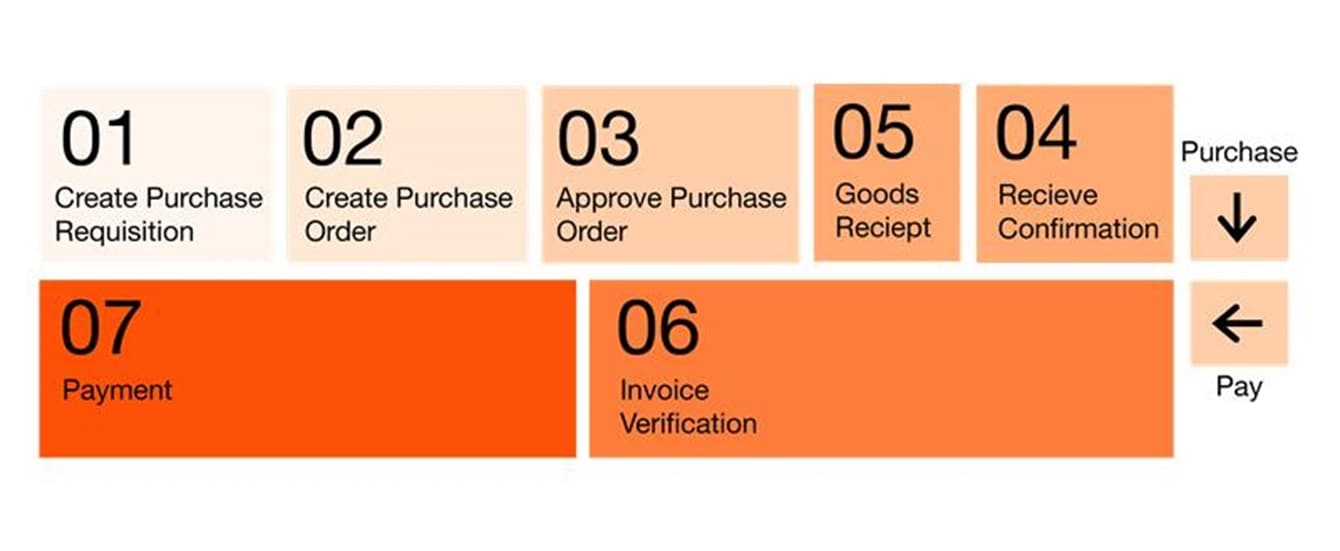
While analysing the P2P cycle, the implementation team should be able to take a holistic approach to process improvement initiatives, since these process cycles overlap with other process cycles (for example, the P2P process is closely interrelated with Accounts Payable (AP) process, which is responsible for managing the payments to vendors and suppliers for goods and services that were procured through the P2P process). The success of such an initiative is extremely dependent on the expertise of the implementation team – a critical expertise being the ability to accurately understand the different needs and requirements of different stakeholders, lay out and categorise the project goals with the objective of driving the project efforts towards scalable value realisation.
Organisations face multiple challenges across the P2P cycle such as delivery day deviations, payment term discrepancies, maverick buying, delayed invoice postings, manual interventions, etc. These have serious implications for business. It is critical that the implementation team has the expertise to strategically frame the project objectives in the light of these challenges uniquely to each organisation. The PwC Signavio Process Intelligence team tailors the project objectives to each client along three strategic vectors – process performance, process compliance, and process quality.



Businesses may want to understand the following:
- The current processing capacity of the departments involved in the P2P and related processes, such as the Purchase department, or the Accounts payable department.
- Time needed by the accounts payable department to verify and process a single invoice.
- “No-touch” orders as a percentage of total Purchase Orders created (i.e., ones that, once created, never needed to be changed during the cycle)
- The average throughput time from the placement of the purchase order to a given stage of the process (say, goods receipt, or payment), considering only the completed orders.
Businesses may want to understand the following:
- Do deleterious activities like maverick buying happen in the P2P process?
- How widespread is the practice of purchase requisitions being changed after the placement of the corresponding purchase order, just to match the information?
Along the process quality vector, the goal is to understand the quality of individual tasks in the P2P process, or identifying unintended behavior in the control flow, such as:
What are the unexpected patterns in the execution of the target P2P process?
For each client, the implementation team must ensure that the objectives along each vector align with the crucial business objectives, and should be able to strategically guide the project towards the realisation of tangible business benefits. To understand this, let us look at the process compliance vector. Maverick buying is an extremely harmful practice where the standard purchase order approval workflow is bypassed, and orders are placed directly with the supplier. The purchase order is then created only after an invoice arrives from the supplier. Problems connected to maverick buying can lead to a number of issues, such as overspending or lack of proper approvals.
SAP Signavio Process Intelligence can be leveraged to identify such instances of maverick buying, upon which, the implementation team can use the insights thus obtained to identify the steps to address the issues leading to such deviations. Recommendations are then tailored based on the analysis of system insights, insights from workshops, and client’s unique situation and business objectives. For instance, in case of maverick buying, they may include updating internal documents with additional instructions and incorporating adjustments to internal training programs to enforce stricter controls and corrective measures, enhancing compliance and improving the purchasing process.
Another example is when SAP Signavio Process Intelligence has identified activities with prolonged cycle times. This is a case highlighting the importance of holistic business expertise of the implementation team – the implementation team must leverage its industry knowledge to conduct workshops with business users and identify ways to circumvent bottlenecks. PwC uses the Pareto principle to identify the most significant contributors to processing time, and outline plans-of-action for implementing effective solutions. In this case, it may, for example, include the design of effective communication strategies between the departments responsible for invoice payments and ordering goods.
Equally deleterious, yet very common, is the Process Compliance issue of post-mortem changes to purchase requisitions, wherein PR documents are changed after their approval to match the amounts/quantities of the purchase order. Similarly, the fraction of “no-touch” orders can be considered as a reasonable proxy for the efficiency of the P2P process – an increase in which, indicates that lesser time and resources are spent on order modifications, leading to a more streamlined process. Process improvement recommendations may include better clerical staff training on order-entry, improved documentation, and even exploring AI-based solutions that can minimise human errors.
These are just some areas where SAP Signavio can help businesses improve their P2P process. Signavio can virtually touch upon, and demonstrate significant improvements in every step of the P2P process, as well as other processes. However, what sets Signavio apart from competitors that the platform’s Process Intelligence capabilities are specifically tailored to SAP environments – it analyses system logs at configurable intervals, facilitates customisable KPI dashboards for real-time process monitoring, as well as automated compliance checking against established SAP S/4HANA best practices. Metrics pertaining to P2P processes such as throughput parameters, cycle times, waiting times, etc. can be configured in Signavio for process efficiency evaluation. The result is a faster, more transparent P2P process that streamlines procurement, strengthens supplier trust, and optimises working capital efficiency for lasting business success.